

Marie-Luise Marjan and Her Rollator "Rudolpho": What Her Story After a Broken Hip Shows
Caspar von HirschhausenShe calls it Rudolpho. Marie-Luise Marjan, known to millions of viewers as Helga Beimer, the "mother of the nation" from the series "Lindenstraße," has given her rollator a name. In a recent interview with BILD, the 86-year-old describes how she learned to walk again with a rollator after a femoral neck fracture and several operations, and why she no longer wants to give it up.
Her story moves many people because it is so honest. At first, Marjan too was reluctant to be seen in public with a rollator. Today she says something we could hardly put better in our own consultations: "It's a gateway to freedom!" In this article, we look at what lies behind her story, what the path from a fall back to everyday life typically looks like, and what you should really pay attention to with a rollator after hip surgery.
Find the right rollator in 2 minutes
Avoid a bad buy: our rollator finder gives you a quick and reliable recommendation for yourself or your family members.
👉 Find the right rollator nowTL;DR, in brief: After a femoral neck fracture and five operations, Marie-Luise Marjan learned to walk again with a rollator during rehab. Today, her rollator "Rudolpho" is not a sign of weakness for her, but a piece of freedom. We see the same thing in our consultations: after a fall or hip surgery, a rollator can offer more safety when walking and a place to sit during breaks. What matters are the right handle and seat height, reliable brakes, and a weight you can lift into the car yourself.
Marie-Luise Marjan and "Rudolpho": Her story
Marie-Luise Marjan has played more than 350 roles in her career. She is best known as Helga Beimer, whom she portrayed from the very first episode of "Lindenstraße" in December 1985. According to BILD, several hard blows came together for her in 2021: the series ended, the lease on her apartment was terminated, and her partner died.
Then came the fall. During an intermission at a theater in Hamburg, she missed an unlit step. The diagnosis was a femoral neck fracture. A long period of suffering followed, with five operations in total. In rehab, she received her first rollator and learned to walk again with it.
Today she takes walks along the Rhine with her rollator, stops for breaks along the way and sits down whenever she likes. When friends wanted to pick her up for a walk, she announced her "new friend." The surprise was great when, instead of a new man, Rudolpho stood at the door. Even if she can one day walk without help again, she wants to keep him.

Since the end of October 2026, Marie-Luise Marjan has also been a brand ambassador for the rollator manufacturer Saljol. According to Saljol, the collaboration began with a newspaper photo showing her with a Saljol rollator. In the full interview on Saljol's YouTube channel, she tells her story herself:
Video: Saljol on YouTube
What many people don't know: Giving a rollator a name is not all that unusual. Anyone who names their rollator has usually already accepted it as a companion. And a rollator that is accepted also gets used.
Rollator after a femoral neck fracture: The way back
A femoral neck fracture is one of the most common injuries in older age, and very often the cause is a fall in everyday life. A step, a rug, a brief moment of inattention. In most cases the fracture is treated surgically, either with a hip replacement or by fixing the bone.
The answer to the question of what happens next depends heavily on the type of fracture, the type of operation and your own starting point. Roughly speaking, however, the path can often be divided into three stages:
- In the hospital: Mobilization usually begins as early as the day after the operation, initially with help from the nursing or therapy team. The hospital determines how much weight may be put on the operated leg.
- In rehab: Here, walking is practiced in a targeted way, often first with a rollator or walker and later, depending on progress, with forearm crutches. This was also the case for Marie-Luise Marjan.
- At home: According to medical information, special care is usually still needed for one to three months after discharge. Many people use the rollator during this time for longer distances, shopping or walks.
For many, this last step is the most important one. Anyone who fears another fall after a first one often moves less. This weakens the muscles and increases the likelihood of another fall. A rollator can help break this cycle because it offers support and gives you the courage to go outside again.
Our tip: While still in rehab, talk to your physical therapists about which walking aid makes sense for home and how the handles and seat should be adjusted. Then the right rollator will be ready when you get home, and you won't have to improvise with a loaner.
"Gateway to freedom": Why shame is often the bigger hurdle
Marie-Luise Marjan says openly that at first she did not like being seen with a rollator. Her profession was always tied to her appearance as well. Many people know this reluctance, even without a camera. "It makes me look old" or "I can still manage without it" are sentences we regularly hear in our consultations.
When Marjan hears today about people who refuse to use a rollator out of pride, she pushes back. Her view has changed because she has experienced for herself what the rollator gave back to her: being out on her own, going for walks, sitting down whenever she wants. Life does not get smaller just because the steps become more careful.
If you or a parent are struggling to accept a rollator, feel free to read our detailed article "Overcoming rollator rejection: Why so many people don't want a rollator and what really helps". For family members, we also have a separate guide to buying a rollator for parents.
What to look for in a rollator after hip surgery
After a femoral neck fracture or a new hip joint, the correct adjustment of the rollator is even more crucial than usual. From our consulting practice, these are the most important factors:
1. The right handle height
Stand upright and let your arms hang loosely. The handles should be roughly level with your wrists. If they are too low, you walk bent over. If they are too high, you lack strength when supporting yourself. You can read more in our article on the correct posture with a rollator.
2. A seat height that suits your hip
After hip surgery, many hospitals advise against sitting low in order to avoid bending the hip sharply. As a rule of thumb, when seated, your hip should be slightly higher than your knee. A seat that is too low is therefore impractical when sitting down and standing up. For taller people, a seat height of around 60 cm is often more comfortable than the usual 50 to 54 cm. Please discuss the exact guidelines after your operation with your hospital or physical therapist.
3. Brakes you can operate safely
To sit down, both brakes must be locked, otherwise the rollator will roll away. Make sure the parking brake engages easily. If one hand has been weakened after a fall, a one-hand brake can be useful.
4. A weight you can manage yourself
In the first weeks after hip surgery, you are usually advised not to lift anything heavy. A rollator that has to be lifted into the car or carried up a step should therefore be as light as possible. Classic models covered by health insurance often weigh 8 to 10 kg, while lightweight carbon rollators weigh 5 to 6 kg. We explain the difference between the materials in "Which is better: a carbon or an aluminum rollator?"
5. Useful equipment for the transition
A cane holder is practical if you are already covering short stretches of the way back with a walking stick. A tipping aid makes it easier to get over curbs, a bag keeps your hands free, and a back strap makes breaks on the seat more comfortable.
Suitable models
For people who want to become active again after an operation and value low weight, we mainly recommend lightweight carbon rollators with full equipment. From the range of Saljol, the manufacturer behind Marjan's rollator, this is our favorite:
Saljol Carbon Rollator with full equipment
Weighing around 5.3 to 5.5 kg without accessories, it is one of the lightest rollators in our range and folds to a width of just 21 cm. The full equipment offers much that can help after hip surgery: two parking brakes, a switchable drag brake for slopes, tipping aids, cane holder, back strap, bag, bell and LED light. The version with a seat height of 62 cm is especially comfortable for taller people and anyone who does not want to sit low.
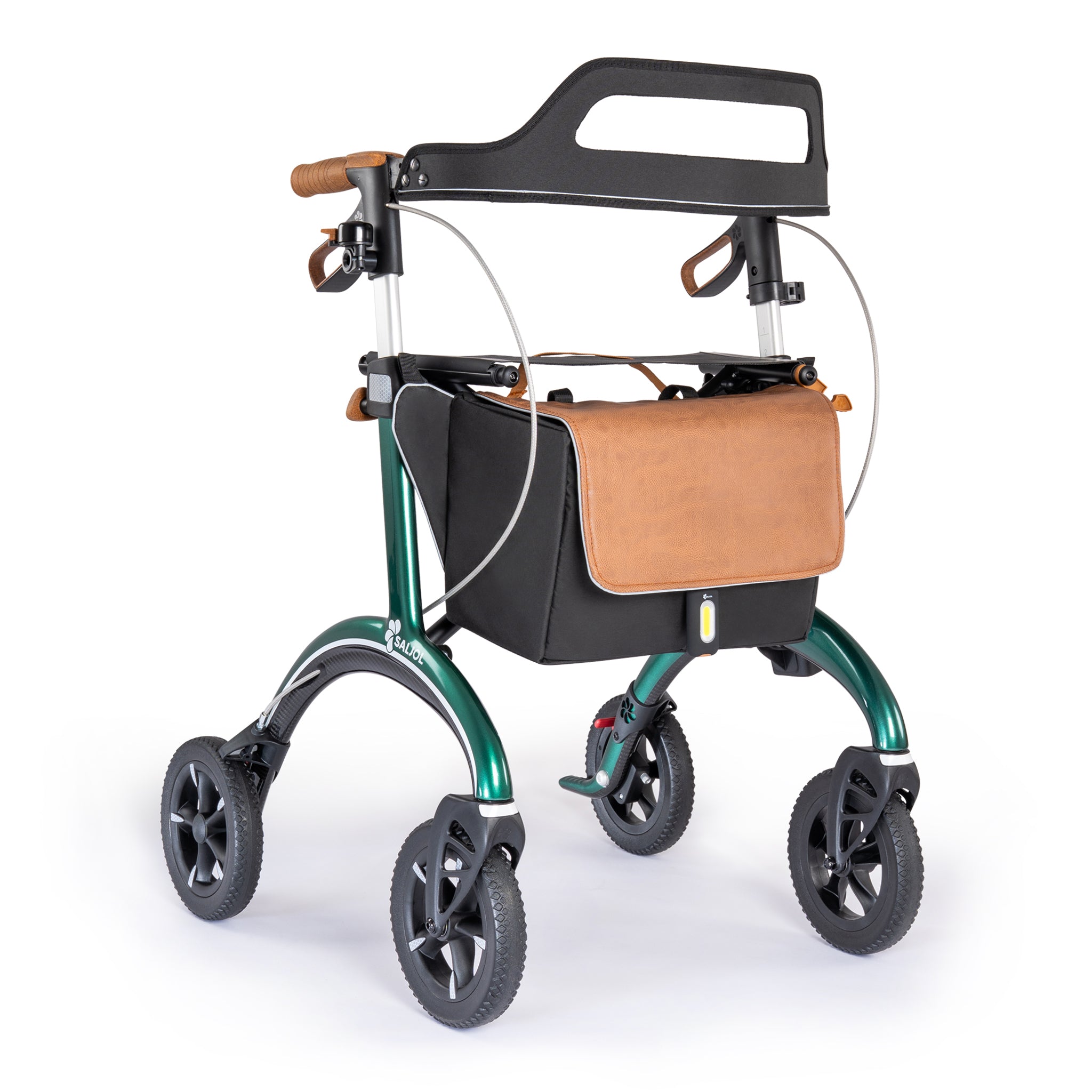
| Weight | approx. 5.3 kg (54 cm) or 5.5 kg (62 cm), without accessories |
| Seat height | 54 cm or 62 cm, extra wide with 62 cm |
| Handle height | 76 to 88 cm or 81 to 103 cm |
| Load capacity | 150 kg, extra wide 180 kg |
| Suitable for | Active people who want to get around safely and easily after a fall or surgery |
Are you looking for a model for indoor use, or would you like to compare several lightweight rollators? You will find more models in our categories carbon rollators and indoor rollators. Our article "What is the lightest carbon rollator?" gives an overview of the lightest models.
Still unsure which rollator suits you?
👉 Find the right rollator nowConclusion
Marie-Luise Marjan's story shows what we see again and again in our consultations: after a fall and an operation, the rollator is often the aid with which the way back to everyday life begins. Those who accept it regain freedom of movement instead of withdrawing out of fear. Whether it then gets a name is a matter of taste. What matters is that it is properly adjusted, brakes safely and is light enough to take along.
So that you can find out at your own pace whether a model suits you, we offer a 50-day everyday test. If you are unsure which model really suits you, we will be happy to help. Contact us at any time by email or by phone at 030 233 27 811.
Frequently asked questions
How long do you need a rollator after a femoral neck fracture?
This varies widely. Some people need the rollator for only a few weeks to a few months, while others use it permanently for longer distances. The decisive factors are the type of operation, muscle strength, balance and fear of falling. Like Marie-Luise Marjan, many people keep the rollator even once they can manage short distances without help again, for example for walks with a seated break.
Does health insurance cover the cost of a rollator after hip surgery?
As a rule, yes, if it is prescribed by a doctor and medically necessary. The statutory co-payment applies. This often happens while you are still in the hospital or in rehab. The insurer then usually covers a standard model through a medical supply store. Lighter models such as carbon rollators usually involve an additional charge or have to be paid for separately. We explain the differences in our comparison: health insurance or paying yourself?
Rollator or forearm crutches after surgery: Which is better?
Both have their place. Forearm crutches are often used to control the load on the operated leg in a targeted way. The rollator offers more stability and a seat, and is well suited to longer distances. The hospital and physical therapy team determine which walking aid makes sense in which phase. You will find a detailed comparison in Which is better, crutches or a rollator?
Which seat height makes sense after hip surgery?
As a rule of thumb, when seated, your hip should be slightly higher than your knee. For taller people, a seat height of 60 cm is often more comfortable than the usual 50 to 54 cm. You can get the exact guidelines after your operation from your hospital. We explain all the important dimensions in What dimensions should a rollator have?
Which rollator does Marie-Luise Marjan use?
Marie-Luise Marjan gets around with a rollator from Saljol, whose brand ambassador she has been since the end of October 2026. Among other things, Saljol makes particularly light carbon rollators, including the Saljol Carbon Rollator with full equipment.
Is it embarrassing to use a rollator?
No. Millions of people in Germany use a rollator, and more and more well-known personalities speak openly about it. Marie-Luise Marjan calls her rollator a "gateway to freedom." Modern models are light, slim and available in attractive colors, and they look more like an everyday accessory than a piece of hospital equipment.
Can I try out a rollator before buying?
Yes. We offer a 50-day everyday test: you try the rollator at your own pace at home and on your usual routes. If it doesn't suit you, we will pick it up again free of charge. On request, we can also assemble the rollator at your home and adjust it to fit you.
Sources
- BILD.de: "Marie-Luise Marjan: Der Rollator ist ein Tor zur Freiheit," October 29, 2026
- Saljol on LinkedIn and YouTube: "Marie-Luise Marjan ist unsere neue Mutmacherin," October 30, 2026
- MSD Manual, Consumer Version: Rehabilitation after a hip fracture
Note: This article is intended as general guidance and does not replace personal medical or therapeutic advice. After a fracture or an operation, please follow the instructions of your hospital, doctor or physical therapist. The information about Marie-Luise Marjan comes from the sources listed. Rollator Experten is a specialist retailer of Saljol products and has no personal connection to Ms. Marjan.