

Alternatives to the rollator – what other mobility aids are available?
Leonard BalzerA rollator provides significant support for many people in their daily lives. However, there are situations where a traditional rollator is not the ideal solution or is initially perceived as too large, too conspicuous, or too inflexible. Especially at the onset of mild gait instability or when the intended use is clearly limited, the question often arises whether there are viable alternatives to a rollator.
In this guide, we provide an objective overview of 13 different mobility aids that can be used as an alternative or supplement to the rollator.
Table of contents
- Why even consider alternatives to a rollator?
- Walking stick and crutches
- Delta wheels
- Special rollators
- Furniture and walls
- Four-legged walking aids
- The walking frame
- Wheelchair & Wheellator
- Other alternatives to the rollator
- What matters when making your selection
- Common mistakes when choosing alternatives
- Conclusion
Alternatives to rollators can be useful if walking ability is only slightly impaired, the intended use is clearly limited, or the use of a rollator is initially rejected for aesthetic reasons. Which solution is suitable depends on individual needs, the intended use, and personal feelings of security.
Why even consider alternatives to a rollator?
Not all limitations in mobility are the same. While some people primarily suffer from balance problems, others mainly need relief for their joints or muscles. External factors also play a role, such as living space size, location of use, or whether the aid is intended for permanent or occasional use.
Typical reasons for seeking alternatives to the rollator include:
- The uncertainty is still low.
- Support is only needed in certain situations.
- Narrow living spaces make it difficult to use a standard rollator.
- The weight or size of a rollator is perceived as a hindrance.
- There is a desire for a solution that is as inconspicuous as possible.
In all these cases, it may be useful to consider other mobility aids before making a decision.
Walking sticks and crutches as a simple alternative
The walking stick is one of the best-known and most frequently used mobility aids. It is particularly suitable for minor balance problems or for providing temporary relief to one leg, for example after surgery or in cases of osteoarthritis.
A major advantage of walking sticks is their ease of use. They are lightweight, space-saving, and easy to carry. Visually, they are often perceived as less conspicuous than a rollator. Some people even find them particularly elegant.

The classic mobility aid: a wooden walking stick
At the same time, the walking stick has clear limitations. It offers only very limited fall protection, as the support surface is small and there are no brakes. In cases of greater instability or over longer distances, a walking stick is generally insufficient to guarantee adequate safety.
Walking aids, also known as forearm crutches, offer somewhat more stability than a traditional walking stick, but require coordination and arm strength. They are also best suited for temporary limitations or short distances. Visually, walking aids (often simply called crutches) usually resemble those used in acute illness or rehabilitation.

Usually for acute problems: a forearm crutch made of plastic
Delta bicycles – the agile solution on three wheels
The delta walker, often also called a three-wheeled rollator, is an interesting intermediate solution for people who find a standard rollator too bulky and a walking stick too unsafe. Its design with only one front wheel makes it extremely maneuverable and easy to navigate even in very narrow hallways or small bathrooms. Furthermore, delta walkers are usually lighter and fold up particularly compactly.
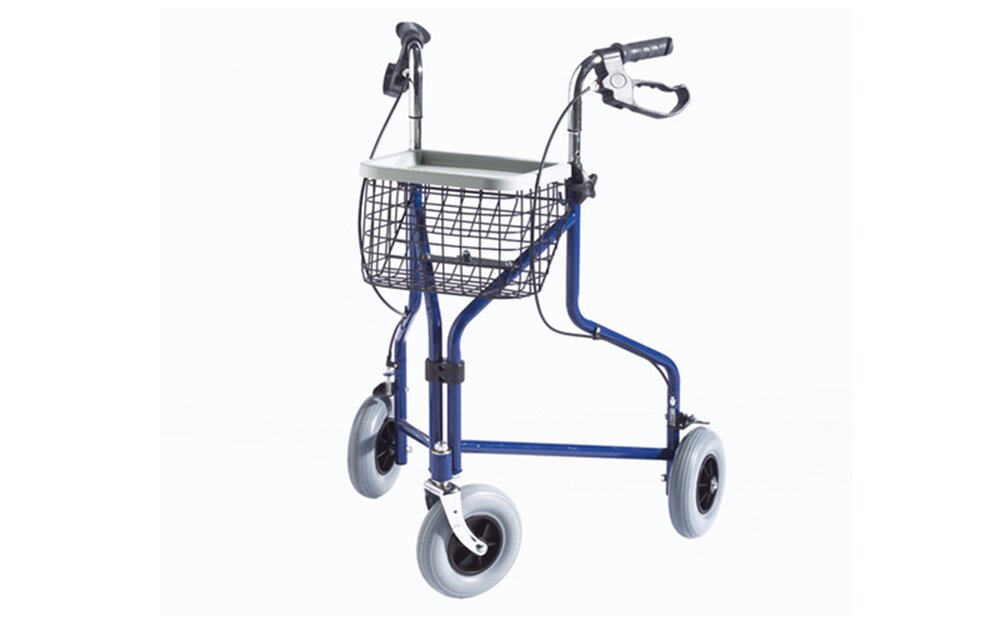
Delta bicycles come in all colors and shapes.
However, this maneuverability comes at a price: Due to its design, it is less stable than a four-wheeled model. It is more prone to tipping over when leaning heavily on it or shifting your weight laterally. Furthermore, since it usually lacks a seat, the delta walker is primarily suitable for individuals who still possess good basic stability and are simply looking for lightweight assistance for short distances.
Special rollators such as indoor rollators
When it comes to alternatives to the classic rollator, indoor rollators are often overlooked, even though they represent a very suitable solution for many people. They are specifically designed for use indoors and differ significantly from standard or outdoor rollators.
Indoor rollators are particularly narrow, maneuverable, and lightweight. They can be easily maneuvered through narrow doorways and offer significantly more stability than a walking stick or using furniture for support. Many models feature built-in trays or baskets that further simplify everyday life.
 The Saljol indoor rollator can also be used as a chair.
Especially for people who spend a lot of time in their own home and feel insecure, but don't yet want to use a rollator outside, an indoor rollator can be a sensible first step to greatly reduce the risk of falling and to maneuver more comfortably through their own four walls.
Furniture and walls as a supposed alternative
When first feeling unsteady, people often resort to using furniture, walls, or door frames to move around. From an expert perspective, this is not a recommended alternative to a rollator or other walking aids.
Furniture is not designed to bear weight or provide support in all areas. It can slip or tip over, significantly increasing the risk of falls. Constantly leaning against walls also leads to unsteady movement patterns and can cause further problems in the long run.
When furniture is used for support, this is often a sign that suitable mobility aids are lacking.
Four-legged walking aids for short distances
Four-legged walking aids offer a larger base than a walking stick and therefore greater stability. They stand independently and do not tip over, which is a safety advantage for some users.

However, these walking aids need to be lifted and repositioned while walking. This requires coordination and strength and can be tiring in the long run. Therefore, they are best suited for short distances, such as within a room or for going to the toilet.
Four-legged walking aids are generally less suitable for longer distances or outdoor use. Again, they lack brakes and therefore do not offer active fall protection.
The walking frame for maximum stability
If gait instability is very pronounced, or if a leg is temporarily restricted to minimal weight-bearing after surgery, a classic walking frame (also called a walking aid) offers the highest stability among hand-operated walking aids. Since it has no wheels, it cannot roll away, providing maximum security while standing. The disadvantage lies in the movement: the walking frame must be slightly lifted and moved forward with each step. This requires arm strength and a certain degree of coordination, and the walking speed is very slow.
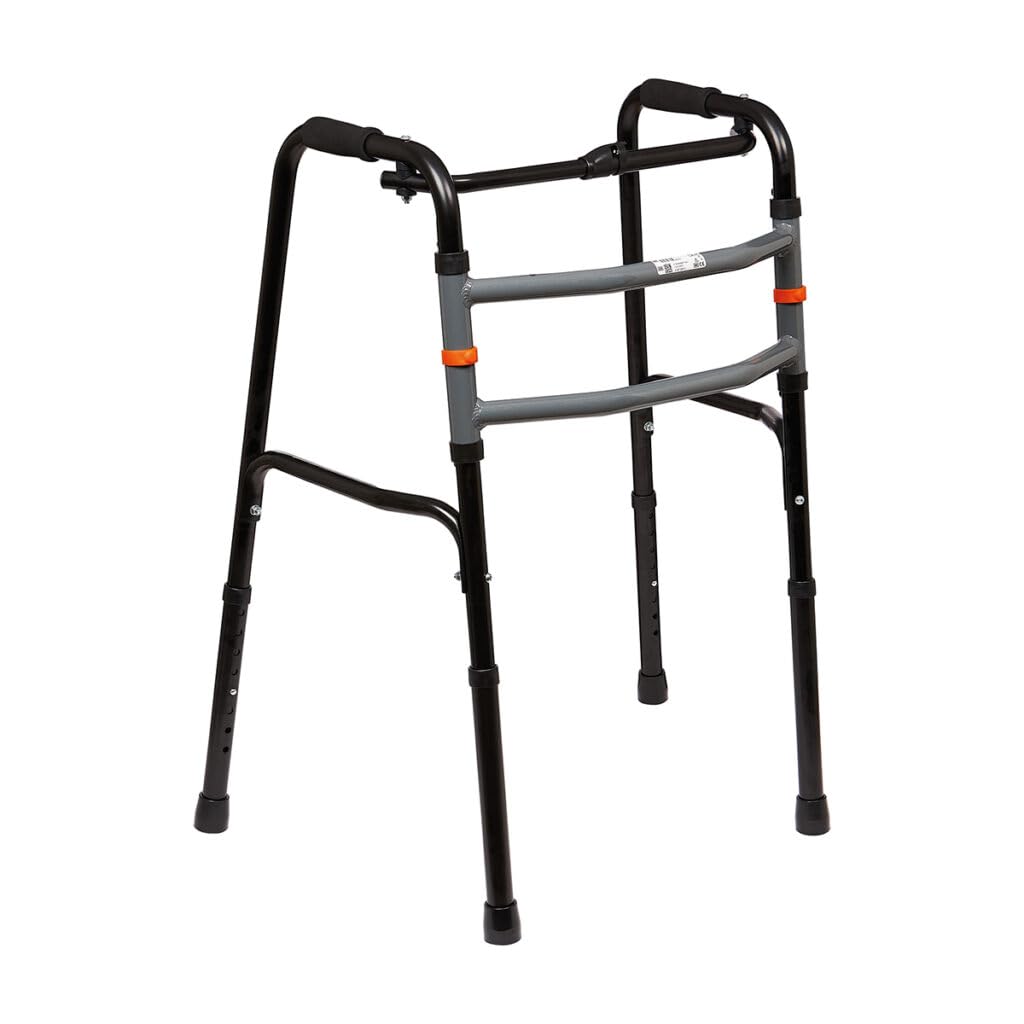
A walking frame typically has no wheels or at most two.
Therefore, the walking frame is used almost exclusively indoors and for very short distances – for example, for transferring from bed to an armchair. It is less of a mobility aid for walks and more of a safety anchor for taking those first steps in one's own home.
Wheelchair as a situational alternative
A wheelchair is often perceived as a drastic measure, but in certain situations it can be a useful addition or temporary alternative. Especially in cases of severely limited walking ability or when traveling longer distances, a wheelchair can provide relief and enable mobility that would otherwise be impossible.

For people who are still generally able to walk, a wheelchair is usually not a permanent solution for everyday life. However, it can be useful for outings, doctor's appointments, or during periods of increased physical exertion. It is important not to see the wheelchair as a replacement for movement, but as support in specific situations.
The Wheellator from Finland is also worth a look. It's a combination of a rollator and a wheelchair. The manufacturer advertises that it combines the advantages of both in one device. This makes it the ideal solution for people with limited mobility and varying needs, who might otherwise have to buy both devices separately.

The Wheellator is a combination of wheelchair and rollator
Other alternatives to the rollator that may be useful depending on the situation
In addition to the walking aids mentioned, there are other mobility aids that can be used as an alternative or supplement to a rollator in certain situations. These solutions are less common but can be useful for specific needs.
Forearm walker
Forearm walkers represent an intermediate solution between rollators and therapeutic walking trainers. Instead of the classic hand grips, users support themselves with their forearms. This relieves strain on the hands, wrists, and shoulders and can be helpful for people with rheumatic diseases or limited grip strength.

This type of walking aid offers high stability but is larger and less maneuverable than a classic rollator. It is frequently used in therapeutic settings or for clearly defined applications.
Electric vehicles and e-scooters
Electric mobility aids such as electric mobility scooters or e-scooters are often sought as an alternative to rollators, but they are not walking aids in the traditional sense. They are suitable when the user is no longer able to walk at all or when longer distances can no longer be covered on foot, but independence outdoors should be maintained.

Electric mobility scooters are unsuitable for use in the home or for short distances. Furthermore, they do not replace walking aids, but rather supplement mobility in specific situations.
Strength training or physiotherapy
In certain cases, targeted strength training or physiotherapy can be a sensible alternative to a mobility aid. Exercises to strengthen muscles, improve balance, and train safe movement patterns can partially stabilize or improve walking ability. However, this requires that there is no acute risk of falling and that the training is professionally supervised.

Targeted training can strengthen muscles and potentially restore safety while walking.
What really matters when making a selection
The question of the right alternative to a rollator cannot be answered in general terms. The individual situation is always the deciding factor. Important factors in the selection include:
- the place of use, i.e. apartment or outdoor area
- the degree of gait instability
- the ability to safely support weight
- the living space situation with door widths and space conditions
- the willingness to use a mobility aid regularly
Especially indoors, it often becomes apparent that a solution specifically designed for this purpose offers more security than seemingly simpler alternatives. Everyday safety should always take precedence over appearance or habit.
Do you or a family member feel unsteady when walking and don't know which walking aid is right for you? Our rollator experts are happy to help and provide personalized advice tailored to your individual situation. You can find our contact information here.

Common mistakes when choosing alternatives
Similar incorrect decisions are encountered repeatedly in practice. These include:
- Hesitation for too long in the face of increasing uncertainty
- Choosing a solution that is too unstable due to shame or uncertainty
- the use of aids outside their intended area
- The decision based solely on price rather than function
The key is finding the right time. Not too early, while the body can still manage walking independently, but also not too late, when the risk of falls increases significantly or those affected withdraw from social life and lose independence because walking becomes increasingly difficult. Objective advice can help avoid these mistakes and find the appropriate support in a timely manner.
Frequently Asked Questions
When are alternatives to a rollator useful?
If the gait instability is only slightly impaired or support is only needed in certain situations.
When is a walking stick sufficient?
For mild balance problems or for temporary relief, usually for short distances.
Who is a delta bike suitable for?
For people with good basic stability who are looking for agile support when walking and help when carrying things like shopping for short distances.
When is an indoor rollator the right choice?
When you spend a lot of time at home and the paths between rooms become increasingly challenging, you shouldn't underestimate how many falls happen in your own home. It's essential to prevent them.
Why is holding onto furniture and walls not a safe alternative?
Because furniture can slip or tip over, increasing the risk of falls.
When can a wheelchair provide relief?
For severely limited walking ability or longer distances, for example on excursions or doctor's visits.
Conclusion
Alternatives to rollators can be useful in many situations, especially for those with mild gait instability, limited mobility, or specific living conditions. Walking sticks, walking aids, and indoor rollators each offer different advantages, but also have clear limitations.
It is crucial to realistically assess one's own situation and not underestimate safety. In many cases, a well-adjusted rollator, adapted to the specific area of use, represents the safest and most comfortable long-term solution.
If, after this overview, you are considering which solution is right for you, we at Rollator Experts will be happy to personally assist you in selecting a suitable mobility aid.